Turkish vs Pakistani Sherwani: What's the Difference and Which Should You Wear?
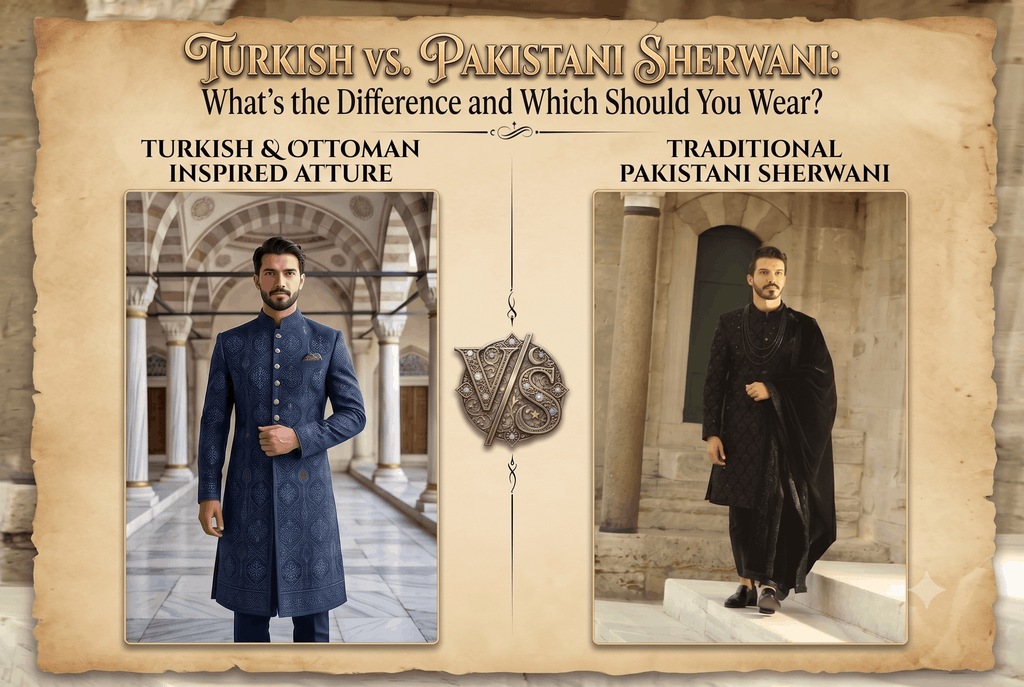
Choosing a sherwani is one of the most important decisions a groom makes. But in 2026, that decision has become more interesting than ever before. Alongside the classic Pakistani sherwani that has defined weddings for generations, a newer influence has entered the conversation. The Turkish sherwani, inspired by Ottoman craftsmanship, is now being worn by grooms who want something that feels culturally rich but visually distinct.
At HS Menswear in Bradford, both styles sit side by side. Grooms come in asking the same question: what actually is the difference, and which one is right for me?
This guide answers both.
But, let's review inshort before getting in details. NOW!
Feature |
Pakistani Sherwani |
Turkish Sherwani |
|---|---|---|
| Origin | Mughal era, South Asian royal court | Ottoman ceremonial dress |
| Embroidery Style | Chikankari, zardozi, thread work with floral/vine patterns | Geometric patterns, Ottoman paisleys, symmetrical borders |
| Silhouette | Longer, closer to ankle length | Structured, close-fitted, slightly shorter |
| Collar | Bandhgala collar | Nehru collar |
| Fabric | Silk, brocade, velvet, jamawar | Jacquard weaves, premium velvet, cotton blends |
| Best Season | Winter weddings (velvet/jamawar) | Summer or destination weddings (lighter jacquard) |
| Best Occasion | Nikah, Walima | Reception, multi-event weddings, destination weddings |
| Accessory Requirement | High (turban/sehra, stole, mojri, brooch, kalgi) | Low (coordinated shawl often included) |
| Visual Feel | Organic, heritage-driven, traditional | Architectural, structured, modern |
| Paired With | Churidar or shalwar | Slim-cut trousers, white kurta underneath |
| Who It Suits | Grooms prioritising cultural tradition and family expectations | Grooms wanting a fashion-forward, visually distinct look |
| HS Menswear Recommendation | Nikah and Walima ceremonies | Reception or as second look in multi-event weddings |
Where Each Style Comes From
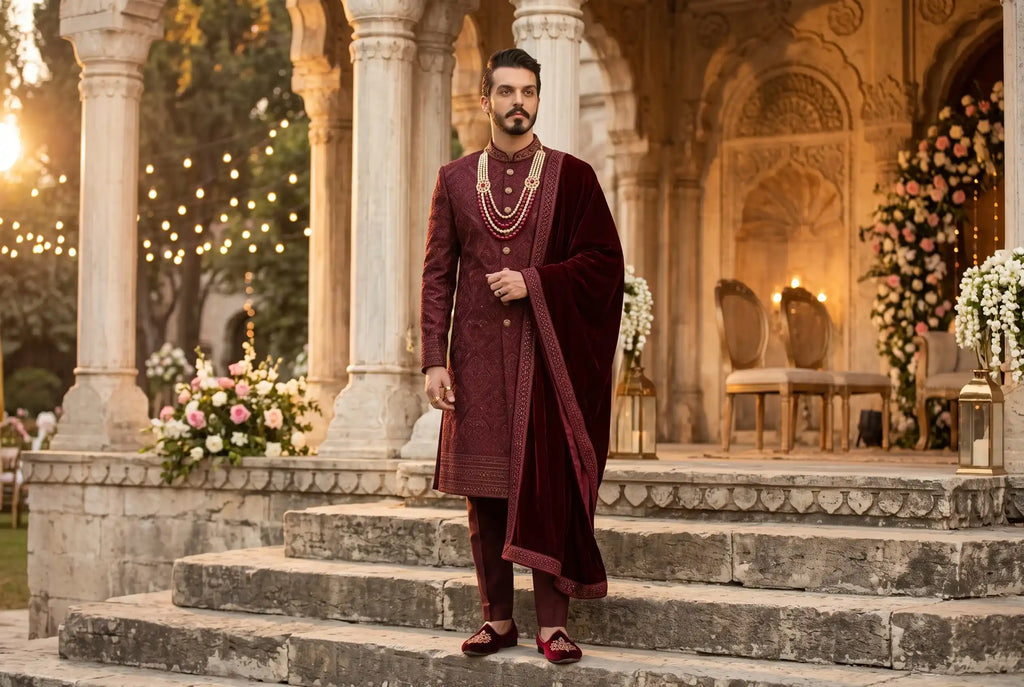
The Pakistani sherwani has deep roots in the Mughal era. It grew out of royal court dress and became the defining garment of South Asian groom fashion over centuries. In Pakistan specifically, the sherwani developed a long, flowing silhouette paired with restrained but high-quality embroidery. It is a look that communicates heritage, dignity, and cultural pride. For most British Pakistani families, the sherwani worn at a nikah or baraat carries decades of family memory with it.
The Turkish sherwani is a newer concept in the UK groomwear market, but its artistic roots go just as deep. Drawing from Ottoman ceremonial dress, with geometric motifs, ornamental borders, structured cuts, and a bolder use of texture, the Turkish sherwani brings a different kind of regality to the table. HS Menswear's Turkey Collection was built around this heritage, combining traditional Ottoman-inspired embroidery with modern tailoring to create a look that feels simultaneously historic and forward-thinking.
Both styles honour tradition. They just come from different traditions.
The Key Differences in Design
The most visible difference is in the embroidery. Pakistani sherwanis typically feature chikankari, thread work, or zardozi. These are techniques that trace intricate floral or vine patterns along the collar, cuffs, and hem. The embroidery is detailed and often dense, but it follows a familiar grammar of South Asian craftsmanship that most families immediately recognise.
Turkish-inspired sherwanis use a different visual language. Geometric patterns, Ottoman paisleys, and symmetrical border designs replace the flowing South Asian motifs. The result feels more architectural. Where a Pakistani sherwani draws the eye through organic embroidery, a Turkish sherwani commands attention through structured pattern and contrast.
The silhouette also differs in important ways. Pakistani sherwanis tend to run longer, closer to ankle length, and are typically paired with a churidar or shalwar. The shape is dignified and traditional, with a bandhgala collar that many UK Pakistani grooms associate specifically with nikah and walima ceremonies.
Turkish-style sherwanis from HS Menswear's collection feature a more structured, close-fitted silhouette with a Nehru collar, sharper shoulder construction, and a slightly shorter cut that reads as modern without losing its formal quality. The HS Menswear Black Turkish Royal Sherwani, for example, is crafted from premium velvet with black-on-black embroidery and a tailored slim fit. It was designed specifically for evening ceremonies and nighttime receptions.
Fabric and How It Feels
Fabric is where you feel the difference more than you see it. Traditional Pakistani sherwanis are made in silk, brocade, velvet, or jamawar, each fabric carrying its own ceremonial weight. Velvet and jamawar are particularly popular for winter weddings in the UK. They are warm, they photograph beautifully under indoor lighting, and they carry a sense of occasion that lighter fabrics cannot replicate.
HS Menswear's Turkey Collection works with jacquard weaves and premium velvet alongside breathable cotton blends for lighter pieces. The ivory Turkish sherwani in the collection uses raw silk with antique gold embroidery and a dual-tone velvet shawl. It is a combination that feels luxurious without the heaviness of a full Mughal-style sherwani. For summer weddings or destination settings, the Turkey Collection's lighter jacquard options offer a level of comfort that traditional Pakistani heavy brocade cannot always match.
If your wedding is in December at a banquet hall in Bradford, a jamawar or velvet Pakistani sherwani will serve you better from a comfort perspective. If your reception is in August or you are attending a garden event, the Turkish collection's lighter options give you elegance without overheating.
Which Occasions Suit Each Style
The Pakistani sherwani is the natural choice for a nikah. It communicates religious and cultural seriousness through its length, its restrained silhouette, and its connection to shared family memory. Most imams and traditional families expect to see the groom in something that reads as clearly South Asian in its heritage, and the classic Pakistani sherwani delivers exactly that. It is also the stronger choice for walima, where the formality of the occasion demands something with presence.
The Turkish sherwani works exceptionally well for receptions and multi-event weddings where the groom wants a different look for each function. Because it draws from a different visual tradition, it creates contrast. The nikah in a classic Pakistani sherwani, the reception in a Turkish-inspired velvet piece. This is something HS Menswear actively helps clients plan for, with consultation sessions built around sequencing the groom's looks across multiple events.
The Turkish style also suits destination weddings particularly well. Several pieces in HS Menswear's Turkey Collection are designed with travel in mind, with lighter fabrics, cleaner lines, and a silhouette that does not require the same level of accessorising that a full Pakistani ceremonial sherwani typically demands.
Accessories and Styling Logic
A traditional Pakistani sherwani calls for coordinated accessories. Turban or sehra, matching stole, mojri shoes, and often a brooch or kalgi. The complete look is intentional and assembled. Missing any one element can make the outfit feel incomplete.
Turkish-style sherwanis are more self-contained. The structure and embroidery do most of the work, which means the accessory load is lighter. A velvet shawl from the Turkey Collection, for instance, replaces the traditional dupatta or stole while adding its own visual statement. HS Menswear pairs many of its Turkish pieces with a coordinated shawl included as part of the outfit. The Royal Ivory Turkish sherwani comes with a dual-tone velvet shawl in deep maroon and mustard gold that completes the look without requiring additional styling decisions.
This makes the Turkish sherwani a practical choice for grooms who want to look exceptional without spending hours coordinating accessories.
What HS Menswear Recommends
The honest answer is that there is no universal right choice. It depends on your wedding format, your family's expectations, your body type, and what you want to feel like on the day.
If your priority is honouring a traditional ceremony with a look your entire family will recognise and respect, a well-tailored Pakistani sherwani in a premium fabric is still the gold standard. HS Menswear's custom fitting service ensures that the classic silhouette looks contemporary rather than dated. Fit is what separates a sherwani that looks rented from one that looks owned.
If you want something that distinguishes you visually, makes a statement in photographs, and feels like a considered fashion choice rather than a cultural obligation, the Turkey Collection offers looks that achieve all of this while staying formally appropriate for UK Pakistani weddings.
For grooms with multiple events, HS Menswear often recommends using both. A Pakistani sherwani for the nikah and a Turkish-inspired piece for the reception. It gives the wedding a visual narrative that guests and photographers both appreciate.
Ready-to-wear pieces from both collections are available with delivery in 2 to 4 weeks. Custom orders take 8 to 10 weeks, so if your wedding date is confirmed, booking a consultation sooner rather than later is the right move.
Book your styling consultation at hassanshafiqmenswear.com and bring both options to the fitting.
Related post
27
Aug