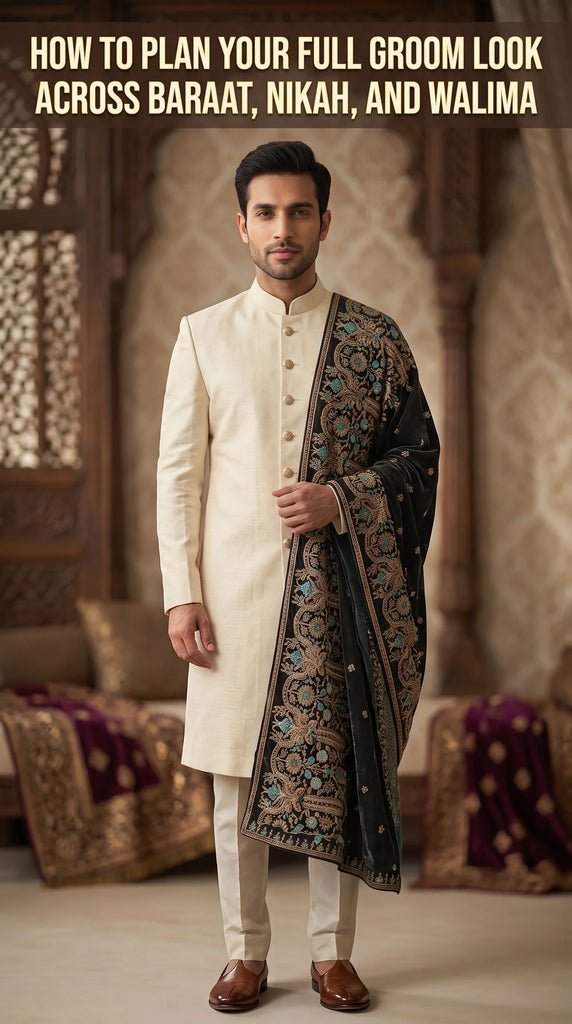
How to Plan Your Full Groom Look Across Baraat, Nikah and Walima
A Pakistani wedding is not one event. It is three. Sometimes four. And each one has its own mood, its own energy, and its own dress code. That means you need three different outfits, and they all need to work together as a group.
Most grooms put all their energy into the baraat sherwani and then scramble to figure out the nikah and walima outfits a few weeks before the wedding. That approach almost always leads to at least one event where the photos do not look great.
Planning your Pakistani groom outfit for the baraat, nikah, and walima from the beginning is the smart move. It saves time. It saves money. And it gives you a visual story across all three events instead of one good look and two rushed ones.
Here is exactly how to do it.
Understanding What Each Event Actually Calls For
Before you start choosing colours and fabrics, you need to understand the atmosphere of each event. Each one has a different feel, and your outfit should match that feel.
The Baraat
The baraat is your procession. It is the grand entrance. There is music, dancing, and the whole family is watching. This is where you wear your most dramatic outfit. Bold colour. Rich embroidery. Full sherwani. This is the event where you are the main character.
In the UK and US, the baraat typically happens at a banquet hall, hotel, or large venue with warm lighting. Your outfit needs to hold up under that lighting and look good from across the room and up close.
The Nikah
The nikah is the Islamic marriage ceremony. It is the most spiritually significant event. The mood is calmer, quieter, and more reverent. Your outfit should reflect that.
Most Pakistani grooms in the UK and US choose white, ivory, cream, or a soft pastel for the nikah. The embroidery is minimal. The silhouette is clean and dignified. This is not the time for a full statement sherwani. It is the time for something that feels considered and respectful.
The Walima
The walima is a celebration hosted by the groom is family after the marriage. It is joyful, social, and usually more relaxed than the baraat. Your outfit can be lighter, more contemporary, and a step down from baraat formality while still looking polished.
Think elegant rather than grand.
|
Event |
Mood |
Formality Level |
Best Outfit Type |
|
Baraat |
Grand, theatrical, celebratory |
Highest |
Full sherwani with heavy embroidery |
|
Nikah |
Spiritual, reverent, calm |
Moderate to high |
Clean sherwani, prince coat, or shalwar kameez |
|
Walima |
Joyful, social, relaxed |
Moderate |
Light sherwani, kurta, or Indo-Western |
Planning Your Baraat Outfit

Your baraat sherwani is the centrepiece of your entire wedding wardrobe. This is where you invest the most thought and the most budget.
Start with colour. Deep tones are consistently popular at Pakistani weddings in the UK and US. Navy, bottle green, burgundy, and forest green are all strong choices. Ivory and champagne are classic and timeless. Think about your venue. A banquet hall with warm amber lighting in Bradford or Birmingham makes deep, richly embroidered sherwanis look incredible.
Next, decide on embroidery. Heavy gold zardozi gives you the most traditional baraat look. It catches light beautifully under venue lighting and photographs with real richness. Lighter thread work or chikankari creates a more contemporary feel. If you are going for a Mughal or Ottoman theme, commit to it at this stage.
Order your baraat sherwani first. It takes the longest to produce, especially if you are going for heavy embroidery or a custom design. Custom baraat sherwanis in the UK typically take ten to sixteen weeks. In the US, similar timelines apply through specialist tailors.
The baraat sherwani is your anchor. Everything else flows from it.
Planning Your Nikah Outfit

The nikah outfit should feel like a thoughtful gear change, not a downgrade.
White, ivory, cream, and pale grey are the most popular choices for Pakistani grooms at the nikah in the UK and US. A clean sherwani or shalwar kameez in one of these tones with minimal embroidery carries exactly the right reverence for the ceremony.
A prince coat over a simple kurta is a very popular nikah option right now, especially in Bradford and across the UK. It is more structured than a kurta alone but less elaborate than a baraat sherwani. It looks formal and intentional without being over the top.
If you want visual continuity between your baraat and nikah looks, bring back one element from the baraat. Maybe the same gold thread appears sparingly on the nikah outfit that was used heavily on the baraat sherwani. Or the same style of collar appears across both pieces.
This subtle connection makes the two events feel like chapters of the same story rather than two completely unrelated outfits.
Planning Your Walima Outfit

The walima is where you can relax a bit and have fun with your outfit.
Softer colours work well here. Pale blue, light beige, dusty rose, sage green, or soft champagne. A lighter sherwani, a structured kurta, or a contemporary Indo-Western look all work depending on the venue.
Some grooms go for a more Western-influenced look at the walima, especially if the event is at a hotel or modern venue. A structured sherwani-style jacket over tailored trousers, or a Nehru-collar suit in a neutral tone, can bridge Pakistani and Western formality in a way that feels natural and modern.
The walima outfit should feel fresh. You have already worn two impressive outfits. This one can be more relaxed while still looking polished and intentional.
The Visual Thread That Connects All Three Outfits
Even though each outfit is different, there should be something that ties them together. This is what separates a wedding that looks planned from one that looks like three random events.
Here are ways to create that connection:
-
Same embroidery thread colour appearing across all three outfits in different amounts
-
Consistent colour accent, like gold, that appears in different ways across events
-
Same style of footwear across all three events
-
Same kullah or headwear style in different colourways
-
Consistent level of tailoring quality across all outfits
You do not need all of these. Even one consistent thread creates visual cohesion.
Why You Should Plan All Three Together
The single best thing you can do when planning your Pakistani groom outfit for the baraat, nikah, and walima is to plan all three at the same time.
Sit down with your tailor or menswear consultant and lay out all three looks side by side. Make sure they make sense as a group. Make sure the colour story progresses logically from event to event. Make sure the formality level steps down naturally from baraat to nikah to walima.
When you order all three from the same tailor, you also get consistency in fabric quality, colour accuracy, and finishing. Many UK tailors offer a discount for multi-outfit commissions.
Budget Breakdown: Where to Invest
Not every outfit needs the same budget. Here is a general guideline:
|
Event |
Percentage of Total Budget |
Why |
|
Baraat |
50 to 60 percent |
Most photographed, most formal, most complex |
|
Nikah |
20 to 25 percent |
Simpler design, less embroidery, lighter fabric |
|
Walima |
15 to 25 percent |
Most relaxed, can use lighter or ready-to-wear options |
Timeline: When to Start
If you want all three outfits custom made, start the process six to eight months before your wedding for summer events, and four to six months for other seasons.
The baraat sherwani should be ordered first because it takes the longest. The nikah and walima outfits can follow shortly after.
Book all fitting appointments in your diary as soon as they are scheduled. Tailors cannot finish their work if you keep rescheduling.
Planning your Pakistani groom outfit for the baraat, nikah, and walima from the start is the difference between a wedding wardrobe that looks intentional and one that looks improvised. Take the time upfront and you will thank yourself every time you look at the photos.
Ready to plan your full groom wardrobe? Book a consultation at HS Menswear!
Related post
27
Aug