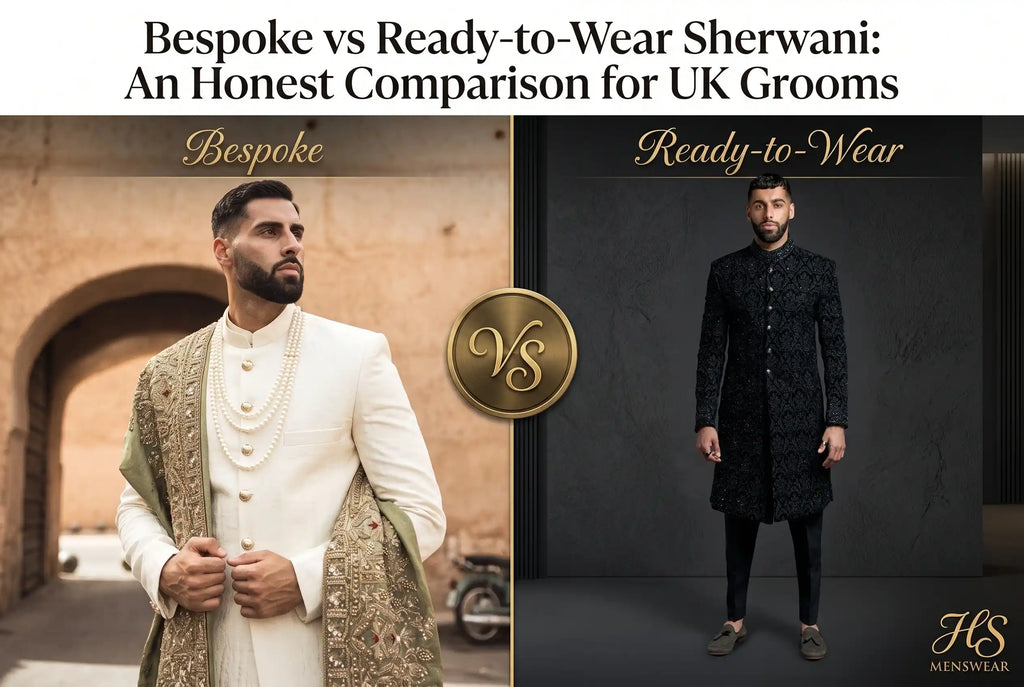
Bespoke vs Ready-to-Wear Sherwani: An Honest Comparison for UK Grooms
So you're getting married. Congratulations. Now comes the part that nobody really talks about. “Figuring out what you're going to wear”
For most South Asian grooms in the UK, the sherwani is the outfit. Whether it's your nikah, baraat, or walima, the sherwani is what shows up in every photograph, every video, and every memory your family keeps for the next 30 years. So the question of bespoke sherwani UK versus ready to wear isn't just about money, it's about what you want to look like on the most photographed day of your life.
This guide gives you the honest version. No fluff, no sales pitch. Just what each option actually means, what it costs, and who each one is right for.
What Does "Bespoke Sherwani" Actually Mean?
The word "bespoke" gets thrown around a lot. Half the time it just means "we'll adjust the sleeves a bit." That's not bespoke.
A true bespoke sherwani is built from scratch using your exact measurements. Your tailor or designer takes your chest, waist, shoulders, back length, sleeves, neck, sometimes 15 to 18 different measurements. The pattern is cut specifically for your body. Nobody else is wearing this shape.
The result? A sherwani that sits on your shoulders properly, closes at the chest without pulling, and falls at the right length for your height. No bunching, no gaps, no awkward collar float.
That's the difference between a sherwani that fits and a sherwani that looks like it fits in the thumbnail but falls apart in full-body shots.
What Is a Ready to Wear Sherwani?
A ready-to-wear sherwani, also called off the rack or RTW. It is made in standard sizes. A manufacturer produces hundreds of the same design in Small, Medium, Large, XL, and so on. You pick one closest to your size, sometimes get minor alterations done, and that's it.
This is what you'll find on most Asian fashion websites, in a lot of UK high street Asian stores, and at market stalls. The price is lower. The wait time is shorter. You can often buy and wear them within days.
But here's the honest part: most men are not standard. Your chest might be a 40 while your waist is a 34. Your arms might be longer than average. You might carry weight in your shoulders but not your stomach. A standard size simply cannot account for all of that.
The Fit: Where the Real Difference Shows
This is the main one.
With a bespoke sherwani, the garment is built around your body. The shoulders sit exactly where your shoulders are. The chest closes without strain. The collar sits flat against your neck. The length is set to your height, not a template.
With ready-to-wear, you're fitting your body into someone else's template. Sometimes it works. If you're close to a standard frame, average height, proportional build, you can find a solid ready-to-wear wedding sherwani UK that needs minimal alteration. But if you're taller than 6 foot, broader in the shoulders, shorter in the torso, or anything outside that middle ground, you'll feel the gap.
Alterations help, but they have limits. A tailor can take in the waist. They cannot rebuild the shoulder line. They cannot change where the embroidery falls. What you bought is what you're working with.
Bottom line on fit: Bespoke wins. No contest.

Cost: What You're Actually Paying For
This is where most grooms start the conversation. Let's be straight about the numbers.
Ready-to-Wear Sherwani Costs (UK Market):
-
Budget tier (£80–£200): Machine embroidery, polyester or synthetic blends, basic construction. Fine for a guest at a casual event. Not where you want to be as the groom.
-
Mid range (£200–£500): Better fabrics — some silk blends, jacquard, or brocade. Decent embroidery. This is where most online Asian fashion platforms sit. Can look good in photos if it fits well.
-
Premium ready-to-wear (£500–£900): Designer labels, hand-finished embroidery, better construction. These start to compete with entry-level bespoke — but you're still not getting a custom cut.
Bespoke Sherwani Costs (UK Market):
A proper bespoke sherwani in the UK typically starts from around £590 and goes up depending on fabric, embroidery density, and how many pieces are included. Most grooms end up between £900 and £2,000 once you factor in fabric upgrades, embroidery choices, and accessories like a turban, belt, or dupatta.
Here's the thing nobody tells you: the gap between mid-range ready-to-wear and entry bespoke is smaller than you think. Once you add £50–£150 in alterations to a £400 off-the-rack sherwani, and it still doesn't fit perfectly, you start doing the maths differently.
Timeline: How Much Time Do You Need?
This matters a lot for UK grooms who are often coordinating across countries, booking venues months in advance, and managing family who fly in from overseas.
Ready-to-Wear Timeline:
-
In-stock pieces: available immediately or within a few days.
-
Made-to-order (where a retailer custom-makes to standard sizes): typically 4–8 weeks.
Bespoke Timeline:
A genuine custom sherwani for groom in the UK needs time. Expect:
-
Consultation: 1–2 hours
-
Design and fabric selection: can happen same day or over a follow-up visit
-
Crafting: 8–16 weeks depending on the designer and complexity
-
Fittings: at least one or two in-person sessions
Rule of thumb: If your wedding is in less than 8 weeks and you haven't started, bespoke might not be possible. Get moving early.
Fabric and Embroidery Quality
When you invest in a bespoke sherwani, you also get to choose the fabric. That's not a small thing.
Premium bespoke houses work with raw silk, silk brocade, jamawar, velvet, and chanderi. These materials photograph differently. They drape differently. They catch light differently. Under the bright lights of a wedding hall or outdoors in natural light, a quality silk sherwani looks rich and textured. A cheap synthetic looks flat.
Ready-to-wear at the lower price points often uses polyester blends. They can look fine in product photos but don't hold up as well in person or over a long day.
On embroidery: bespoke lets you decide where embroidery sits, how dense it is, and what technique is used — zari, zardozi, resham, dabka, or stone work. With ready-to-wear, you get what's already there.
Who Should Go Bespoke?
You should seriously consider a bespoke sherwani if:
-
You're the groom (the main event its worth the investment)
-
You have a body type outside the standard template very tall, very broad, or with a notable height-to-weight difference
-
You have multiple ceremonies and want coordinated outfits made to the same standard
-
You want specific colours to match the bride's outfit
-
You want to wear it again and have it hold value long-term
-
You want to feel completely comfortable all day, not keep adjusting the collar or holding your breath

Who Should Go Ready-to-Wear?
Ready-to-wear makes sense if:
-
You're a wedding guest, not the groom
-
You have a limited budget and the event is lower key
-
You're buying for one specific event with no re-wear plans
-
Your measurements are close to standard and you know from experience you can pull off off-the-rack clothing
-
Your timeline is too tight for a bespoke commission
There's no shame in it. A well-chosen, properly fitted ready-to-wear Asian wedding menswear UK piece can look excellent. The key is knowing your body and being realistic about what alterations can fix.
The Alteration Trap
Here's something that catches a lot of grooms out.
You buy a £350 ready-to-wear sherwani. It's close, but the chest is a bit loose, the waist is slightly wide, and the sleeves are a touch long. You take it to a local tailor. Three or four adjustments later, you've spent another £80–£120. Now you're at £450, and the sherwani still has embroidery positioned for a different body.
Alterations can fix volume. They cannot fix placement. If the chest embroidery was designed to sit at the centre of a 42" chest and you're a 38", that embroidery will sit too low on you. No alteration fixes that.
This is the alteration trap, spending money on changes that improve things but don't fully solve the underlying fit issue.
For UK Grooms Shopping Abroad
A lot of UK-based grooms shop for sherwanis in Pakistan, India, or Bangladesh — either during a visit or by having family send something over.
This can work. If you go in person, get measured properly, and give the designer enough lead time, you can get excellent quality at a lower cost.
The risks:
-
You can't do fittings remotely
-
Returns and alterations across international shipping are painful
-
Customs charges (15–30% depending on origin and value) can significantly increase the real cost
-
If something goes wrong with the fit or craftsmanship, you have very little recourse from the UK
If you do shop abroad, make sure you have all measurements done properly, get a fabric and embroidery sample first, and build in extra time for shipping delays.
What to Ask Before You Buy
Whether you're going bespoke or ready-to-wear, ask these questions:
-
What fabric is this exactly? Get the composition in writing — silk, silk blend, polyester, etc.
-
Is the embroidery hand-done or machine-done? Both exist at every price point. Know which you're getting.
-
What's the lead time? Confirm this in writing with a date.
-
What's included? Sherwani only, or does it come with kurta, churidar, dupatta, belt?
-
What's the alteration policy? Are alterations included or charged separately?
-
Can I see it in person before final payment? Especially important for online orders.
The Honest Verdict
Bespoke sherwani is the better product. On fit, fabric choice, and long-term value, it wins every comparison.
Ready-to-wear sherwani is the more accessible option. It works when your body fits the mould, your budget is tight, or your timeline is short.
For grooms: The person at the centre of the whole event, the recommendation is to go bespoke if your budget and timeline allow it. The difference in photographs is real. The difference in how comfortable you feel all day is real.
For guests and family members, ready-to-wear at the mid-to-premium range is perfectly sensible. You're not in every photo, and the investment doesn't need to be the same.
Why Hassan Shafique Menswear?
At Hassan Shafique Menswear, we specialise in premium South Asian menswear for UK grooms and their families. We work across all ceremony types nikah, baraat, walima and offer both bespoke and curated ready-to-wear options so you can make the right choice for your day.
Our collections are built around real bodies, not templates. If you're looking for a made to measure sherwani UK with proper attention to fabric, embroidery, and fit, get in touch and let's talk through what you need.
Frequently Asked Questions
How much does a bespoke sherwani cost in the UK?
Prices vary by designer and complexity. Entry level bespoke starts around £590 in the UK, with most grooms investing between £900 and £2,000 once fabric and accessory choices are factored in.
How long does a custom sherwani take to make?
Most bespoke houses need 8–16 weeks from consultation to delivery. If your wedding is soon, contact a designer immediately to check availability.
Can ready-to-wear sherwanis be altered to fit well?
Minor adjustments: Waist, sleeves, hem are possible. But embroidery placement and shoulder construction cannot be changed. If the base size is too far off, alterations won't fully fix the fit.
What fabric should a wedding sherwani be made from?
For a groom, raw silk, silk brocade, velvet, or jamawar are the most popular choices. They photograph well and hold their shape through a long day. Avoid synthetic blends for a main ceremony outfit.
Is bespoke always better than ready-to-wear?
For the groom, usually yes. For a wedding guest or family member attending one ceremony, a good quality ready to wear sherwani is a completely reasonable choice.
Related post
27
Aug