How to Coordinate Groomsmen Outfits with the Groom at a Pakistani Wedding in 2026
How to Coordinate Groomsmen Outfits with the Groom at a Pakistani Wedding
A Pakistani wedding is more than a ceremony. It is a multi-day celebration with different events, different moods, and a lot of eyes on the groom and his crew. If you want the whole thing to look polished, you need to think about how to coordinate groomsmen outfits at your Pakistani wedding before anything else.
Too many grooms leave this until the last minute. They tell their boys to "wear something nice" and hope for the best. The result is usually five different shades, three different styles, and photos that look like everyone showed up from a different wedding.
It does not have to be that way. With a simple plan, you can make your groomsmen look sharp, cohesive, and like they actually belong in the same wedding party. Here is exactly how to do it.
Why Coordinating Groomsmen Outfits Actually Matters
Let us be real. Nobody is going to call you out on the day if your groomsmen are wearing slightly different outfits. But when you look back at the photos months later, you will notice it immediately.
A coordinated groomsmen look does three things. First, it makes the groom stand out as the centre of attention. Second, it makes the entire wedding party look professional and put-together in photos. Third, it shows the families on both sides that this wedding was planned with genuine thought and respect.
In cities like Bradford, Birmingham, Manchester, and London where British Pakistani weddings are known for being elaborate and well-produced, the standard is high. Guests notice when the details are right. And they definitely notice when they are not.
If you are planning a Pakistani wedding in the US, the same principles apply. Whether you are in New York, Houston, Chicago, or Dallas, a coordinated groomsmen look lifts the entire event.
Step One: Lock In the Groom Outfit First
You cannot coordinate groomsmen outfits at your Pakistani wedding until the groom has decided what he is wearing. Everything flows from the groom.
Decide your sherwani colour, fabric, and embroidery style for each event. The baraat sherwani is usually the anchor since it is the most formal and photographed outfit. Once that is confirmed, the groomsmen decisions become much easier.
Here is a simple rule: the groom should always be the most dressed-up person in the group. If the groom is in a heavily embroidered burgundy sherwani with gold zardozi, the groomsmen should not also be in heavy embroidery. They should complement the groom, not compete with him.
Three Colour Coordination Strategies That Work
There are three tried-and-tested approaches to colour coordination for groomsmen at Pakistani weddings. Each one works well depending on your style and the formality of your event.
1. Tonal Matching
Everyone wears the same colour family but in different shades. The groom might be in deep navy with silver threadwork. The groomsmen wear lighter shades of blue or grey. This looks clean, modern, and photographs really well under the warm lighting of UK banquet halls.
This approach is popular at weddings in Bradford, Birmingham, and Manchester. It works especially well when the groomsmen are wearing kurtas rather than full sherwanis, because the lighter shade keeps them a step below the groom in formality.
2. Contrast Pairing
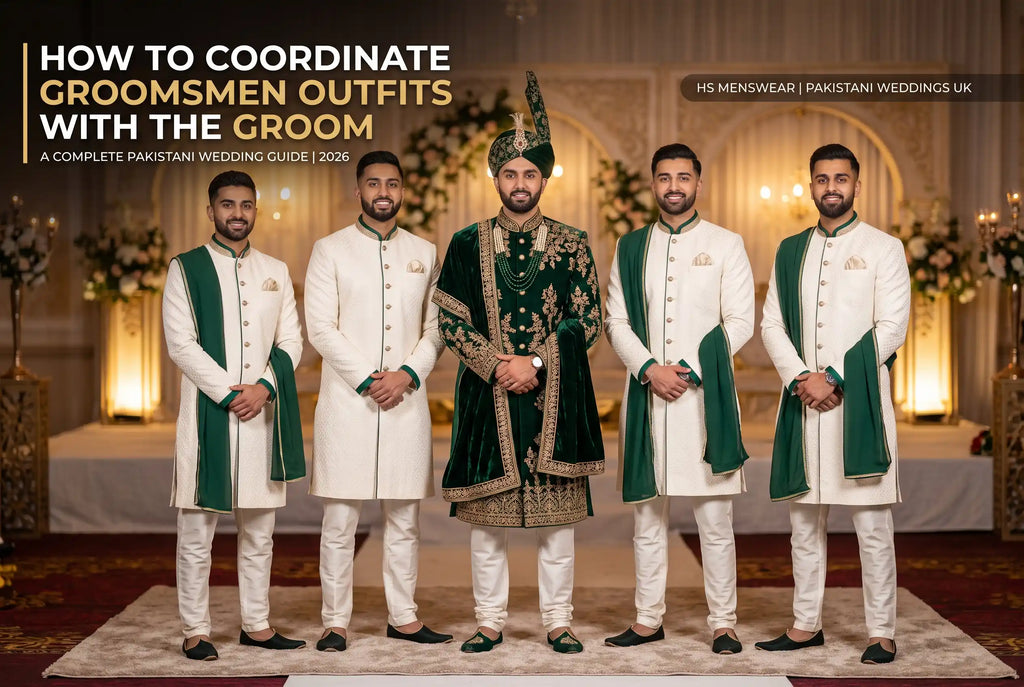
The groom wears one bold colour and the groomsmen wear a neutral. For example, the groom is in bottle green with gold embroidery and the groomsmen are in cream or ivory. This creates a clear visual hierarchy. The groom pops. The groomsmen frame him.
This is probably the most popular approach for baraat events in 2026. It works at any venue size and makes for striking group photos.
3. Theme-Based Coordination
Everyone follows a defined theme. Mughal-inspired, Ottoman, contemporary, or minimal. Every outfit reflects that aesthetic in its own way. The groom goes biggest. The groomsmen carry the theme at a lower volume.
This takes more planning and more budget. But the results are exceptional. If you are going for a themed wedding, your groomsmen outfits need to be part of the theme or they will look disconnected.
|
Strategy |
Best For |
Vibe |
|
Tonal Matching |
Modern, clean weddings |
Understated and cohesive |
|
Contrast Pairing |
Grand baraat events |
Bold and dramatic |
|
Theme-Based |
Mughal or Ottoman themed weddings |
Cinematic and curated |
Getting the Fabric Level Right
Your groomsmen do not need to wear the same fabric as the groom. But the overall weight and feel need to be in the same zone.
If the groom is in a heavily embroidered jamawar sherwani, the groomsmen should not be in plain cotton. That mismatch will be obvious in photos. Instead, aim for a similar level of formality. A structured fabric with light embroidery or minimal detailing works perfectly for groomsmen.
Here is a simple guide:
|
Groom Fabric |
Best Groomsmen Fabric |
|
Heavy jamawar with zardozi |
Structured silk or brocade with light thread work |
|
Velvet sherwani |
Velvet or silk kurta with minimal embellishment |
|
Linen-blend sherwani |
Linen or cotton-silk kurta |
|
Silk with chikankari |
Plain silk or fine cotton with simple piping |
The key takeaway is this: the fabrics do not need to match exactly. But they need to live in the same world.
Silhouette and Fit: Make Sure Everything Is Tailored
One badly fitting outfit in the group ruins the whole look. This is not an exaggeration. In close-up photos and on video, an ill-fitting kurta stands out like a sore thumb.
Groomsmen can wear slim fit or regular fit depending on their body type. What matters is that every single outfit has been properly tailored. Sleeves hit the wrist. Shoulders sit on the shoulder. The hem is the right length.
If you want to coordinate groomsmen outfits at your Pakistani wedding properly, you need to make sure everyone gets fitted. Not just measured. Fitted. At least one fitting appointment per groomsman is the minimum.
This is where ordering from a single tailor helps enormously. More on that below.
Accessories That Tie Everything Together
Accessories are the secret weapon of groomsmen coordination. Even if the main outfits vary slightly, matching one or two accessory elements creates visual unity in every photo.
Here are the most effective accessories for groomsmen coordination:
-
Pocket squares. Matching pocket squares in the same colour and fold style create instant cohesion. This is the easiest and cheapest coordination tool available.
-
Mojri shoes. Coordinated traditional footwear in the same colour or embroidery style across the group looks sharp. Avoid mixing radically different shoe styles.
-
Kullah caps. If groomsmen are wearing traditional headwear, keep the colour consistent. The groom can wear a more elaborate version while groomsmen wear simpler ones in the same fabric.
-
Stoles or dupatta. A matching stole draped in the same way on every groomsman is a simple but powerful coordination detail.
The groom should always have the most notable accessories. His kullah or safa should be the most elaborate. His brooch or kalgi should be the most visible. The groomsmen accessories should complement his without competing.
Planning Across All Three Events
A big mistake many grooms make is only planning groomsmen coordination for the baraat. But a Pakistani wedding has three main events, and your groomsmen are likely at all of them.

Baraat
This is where the most formal coordination happens. Groomsmen in structured kurtas or simple sherwanis that complement the groom in one of the three strategies above. This is the event where colour, fabric, and accessories all need to be dialled in.
Nikah
The nikah is more reverent. Groomsmen can wear simple white, cream, or pale-coloured shalwar kameez. Coordination here can be as simple as everyone wearing the same tone of white or ivory with minimal accessories.
Walima
The walima is more relaxed. Groomsmen can shift into smart casual territory. Structured kurtas in neutral tones, or even well-tailored suits if the venue calls for it. The coordination can be lighter here, maybe just a matching pocket square or the same colour family.
Planning all three events together from the beginning saves time, money, and last-minute stress. Do not leave the nikah and walima as afterthoughts.
Order Everything From One Place
This is one of the most practical pieces of advice in this entire guide. When groomsmen outfits come from different shops, the colours never quite match.
Ivory from one shop is not the same ivory from another shop. Under venue lighting, these differences become very visible. Under camera flash, they become undeniable.
The solution is simple: order all groomsmen outfits from the same specialist. Pakistani menswear tailors in Bradford, Birmingham, and London can handle group orders efficiently. Many offer group discounts when you order three or more outfits together.
Custom groomsmen outfits in the UK typically take eight to twelve weeks. If your wedding is in the summer, start ordering at least four to five months before the date.
In the US, some Pakistani tailors offer similar services, or you can order from UK-based specialists who ship internationally. Either way, ordering together from one source is the move.
Communication: Set Up a Group Chat and Be Clear
The final piece of the puzzle is communication. And this is where a lot of groom plans fall apart.
Do not text each groomsman separately with vague instructions like "wear something blue." You will get six interpretations of blue and six different styles.
Instead, do this:
-
Set up a dedicated WhatsApp or group chat for wedding outfits
-
Share inspiration photos of exactly what you want
-
Share the colour swatch or fabric sample from the tailor
-
Give clear deadlines for measurements and fittings
-
Assign one groomsman as the point person for outfit logistics
Clear communication eliminates confusion. Confusion is the enemy of coordination.
Common Mistakes to Avoid
Here are the most common mistakes grooms make when trying to coordinate groomsmen outfits at a Pakistani wedding:
-
Leaving it until less than two months before the wedding
-
Letting each groomsman source their own outfit independently
-
Not checking all outfits together before the wedding day
-
Forgetting to coordinate accessories
-
Only planning for the baraat and ignoring nikah and walima
-
Choosing a colour that looks great in the shop but terrible under venue lighting
Avoid all of these and you are already ahead of most wedding parties.
Final Thoughts
When you actually plan how to coordinate groomsmen outfits at your Pakistani wedding, the results are immediate. Your baraat looks impressive. Your group photos look like they belong in a magazine. And you do not spend the morning of your wedding panicking about mismatched outfits.
Start with your own outfit. Pick a colour strategy. Match the fabric level. Coordinate the accessories. Order from one place. Communicate clearly. Plan for all three events.
That is it. It is not complicated. It just takes a plan.
Ready to coordinate your whole wedding party? Browse the full groomswear collection.
Related post
27
Aug