Velvet Sherwani in Summer: The Ultimate UK Wedding Guide
Velvet Sherwani in Summer: Is It Still a Good Idea for UK Weddings?
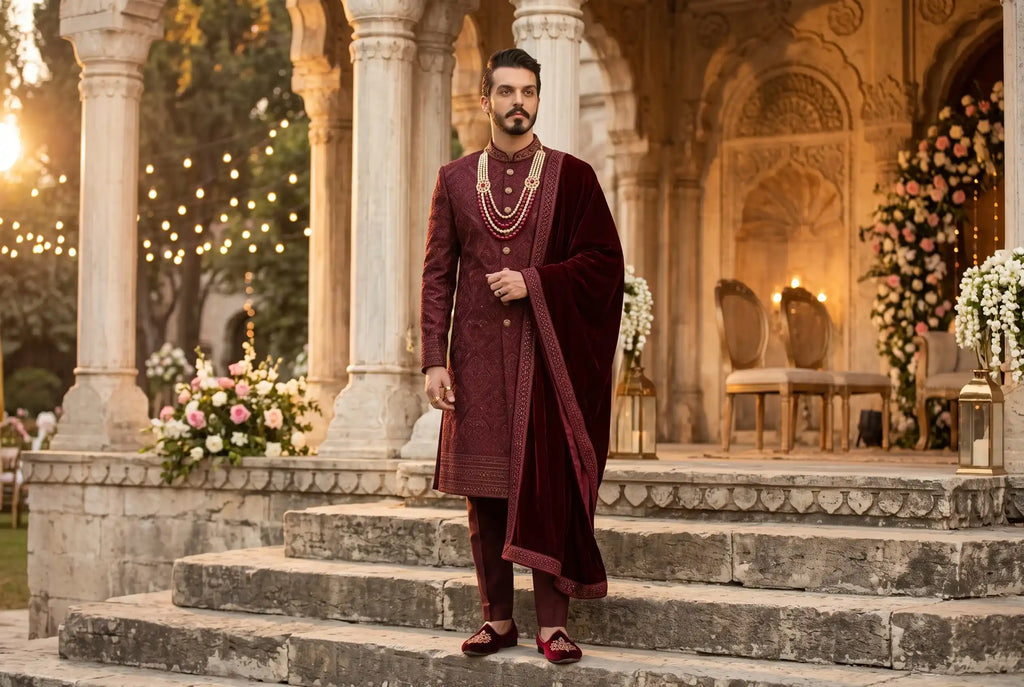
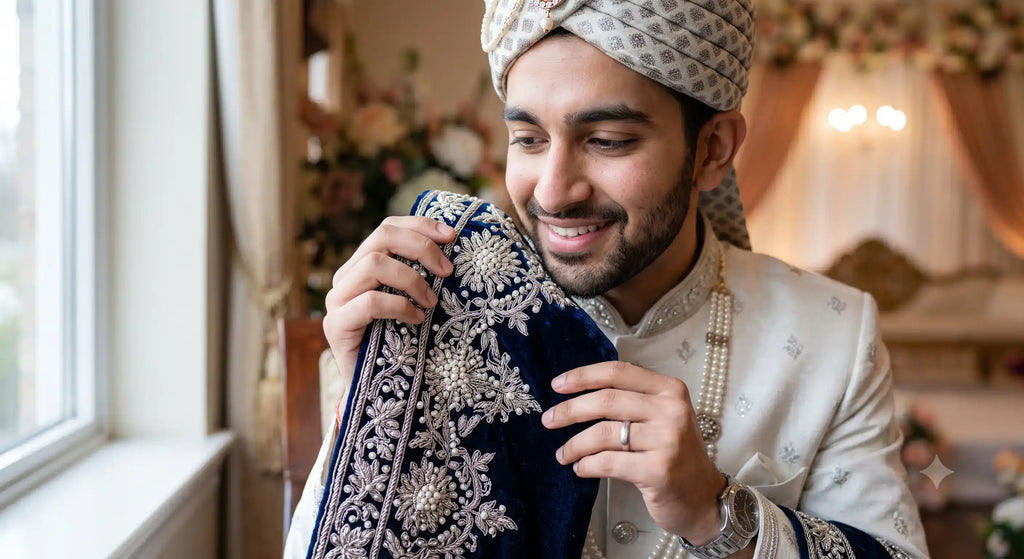
You've found the sherwani. Deep navy velvet, gold embroidery, the kind of outfit that makes you feel like royalty the moment you put it on.
Then someone asks: "Are you sure about velvet? It's a summer wedding."
And now you're second guessing everything.
Here's the honest answer. Velvet in summer is not off the table. But it comes with rules. If you ignore them, you'll spend your wedding day sweating through the baraat. If you follow them, you can still pull off that rich, regal look without suffering for it.
This guide covers everything you need to know. The fabric science, the UK-specific factors that change the equation, a full comparison of your alternatives, and a clear decision framework so you don't have to guess.
Why Velvet Feels Wrong for Summer (And Why UK Is Different)
The general advice around velvet and summer is straightforward. Velvet is a pile fabric, meaning it has a raised, cut surface that traps air and retains heat. It's heavier than silk, brocade, or cotton blends. In warm weather, it works against your body's natural ability to cool down.
In South Asia, that advice is essentially non-negotiable. Wearing full velvet in Lahore or Karachi in June, where temperatures regularly hit 38 to 42 degrees, is not just uncomfortable. It's genuinely difficult to manage for a full day of events.
But the UK is a different country with a different climate entirely.
British summers are mild. June, July, and August typically see temperatures between 17 and 24 degrees Celsius. Heatwaves happen, but they're exceptions. On most summer wedding days in Bradford, Manchester, Birmingham, or London, you're looking at overcast skies, mild evenings, and venues that are built to hold hundreds of guests comfortably.
That context changes the calculus significantly. The question isn't just "is it summer" — it's "what are the specific conditions on the day."
UK Summer vs South Asian Summer: A Quick Comparison
|
Factor |
South Asia (Summer) |
UK (Summer) |
|---|---|---|
|
Average Temperature |
35–42°C |
17–24°C |
|
Outdoor Events |
Common, unavoidable |
Often held in shaded or indoor spaces |
|
Venue Climate Control |
Often limited |
Most banqueting halls fully air-conditioned |
|
Evening Conditions |
Still very warm |
Usually cool to mild (15–18°C) |
|
Sky Conditions |
Bright sun, high UV |
Frequently overcast — less radiant heat |
What makes velvet uncomfortable in summer is not the season on the calendar. It's sustained heat exposure, direct sunlight, and no climate control. In most UK settings, those three factors are rarely all present at once.
The One Rule That Actually Matters: Venue and Time of Day
Before you think about fabric, think about logistics. Two questions determine whether velvet is viable for your wedding:
-
Where is the event happening? Indoor or outdoor?
-
What time of day is it? Afternoon or evening?
These two factors matter more than the month. A June evening reception in a climate-controlled banquet hall in Bradford is a completely different thermal environment than a July afternoon baraat in an open garden.
|
Wedding Scenario |
Velvet OK? |
Recommended Approach |
|---|---|---|
|
Indoor evening reception (banquet hall) |
Yes |
Velvet — ideal setting |
|
Indoor afternoon nikkah |
With Caution |
Velvet blend or lightweight brocade |
|
Outdoor baraat, afternoon sun |
No |
Raw silk or art silk — much safer |
|
Garden wedding, daytime |
No |
Jacquard or cotton-silk blend |
|
Evening valima, indoor venue |
Yes |
Velvet — this is its natural home |
|
Mixed indoor/outdoor day |
With Caution |
Velvet for evening only, change for baraat |
The venue and time of day matter more than the month on the calendar. Plan around your specific schedule, not a general seasonal rule.
Why the UK Wedding Format Actually Favours Velvet
There's something specific about how British Pakistani and British Asian weddings are structured that makes velvet more viable than people assume.
Unlike in Pakistan, where baraats often happen in the open air and evening events can still be warm, UK weddings typically follow a format that works in velvet's favour:
1. Most UK Asian Weddings Are Hall-Based
The majority of Pakistani and Indian community weddings in cities like Bradford, Leicester, Birmingham, and Manchester take place in large banqueting halls. These venues are purpose-built for big gatherings. They have air conditioning, high ceilings, and controlled environments. Velvet in a 300-person air conditioned hall in Manningham is completely manageable.
2. The Baraat Is Usually Short
In UK Pakistani weddings, the baraat, the groom's procession is typically a short outdoor moment before entering the venue. It's not a multi-kilometre outdoor ceremony in direct sunlight. You might be outside for 15 to 20 minutes. In mild UK summer temperatures, that's not enough to cause serious discomfort even in velvet.
3. Evening Receptions Are the Main Event
The grand reception in the UK usually runs from late afternoon into the night. By 7 or 8pm in summer, UK temperatures drop to 15 to 18 degrees. That's prime velvet weather. You'll be comfortable, and the fabric will look incredible under reception lighting.
4. Photography Favours Velvet
Velvet catches light differently than any other fabric. It creates depth and richness in photographs that silk or jacquard can't replicate. If photography and videography are a priority and they usually are velvet gives you a visual edge that holds up across all lighting conditions, from outdoor natural light to indoor venue lighting.
UK Pakistani weddings are largely indoor, evening-focused events. That structure is naturally compatible with velvet in a way that outdoor, all day weddings are not.
How to Make Velvet Work in Summer: Practical Tips
If you've decided velvet is the right call, these adjustments will make a real difference to your comfort and how the outfit holds up across a full wedding day.

1. Go Lighter on the Embroidery
This is the single most impactful change you can make. Heavy zardozi, stone work, and all over embellishment don't just add weight visually, they add physical weight to the garment. A velvet sherwani with dense embroidery will be significantly warmer than a clean, minimal velvet design.
For summer, aim for embroidery concentrated at the collar, cuffs, and placket. Let the velvet fabric itself create the impact. A well chosen deep navy or emerald velvet with restrained embroidery will look more refined than an over-embellished piece anyway.
2. Choose the Right Colour
Colour affects heat absorption more than most people realise. Darker, more saturated colours absorb more radiant heat when exposed to sunlight. For summer events where any outdoor time is possible:
-
Sage green — one of the best summer velvet colours; absorbs less heat, photographs beautifully
-
Steel blue or dusty teal — cool tones that still carry the regal velvet look
-
Champagne or ivory — unusual in velvet but stunning; reflects heat well
-
Dusty rose or warm blush — popular in 2025, lighter and distinctly modern
-
Deep maroon — classic velvet colour but absorbs significant heat outdoors
-
Jet black — the warmest colour choice; best saved for winter receptions
-
Dark navy — slightly better than black but still a heat-absorbing choice for outdoor moments
3. Split Your Looks Across Functions
This is something many UK grooms already do across their wedding events, and it makes total sense from both a style and a comfort perspective.
-
Daytime nikkah or mehndi: Wear a lighter fabric — raw silk, brocade, or a fine jacquard. You'll be comfortable, and you'll look put together without the weight of velvet.
-
Baraat: If outdoors, this is the event to avoid velvet. A beautifully tailored silk sherwani for the procession is a better choice.
-
Evening reception or valima: This is velvet's home. The lighting, the indoor setting, the evening temperature — everything works in its favour. Save the velvet for this moment.
Two or three distinct looks across a wedding weekend is not unusual. It gives you variety and means each outfit is matched to the right conditions.
4. Ask About Velvet Blends and Velveteen
Fabric technology has moved forward. Velveteen and silk-velvet blends are now widely available and they mimic the visual texture and depth of traditional velvet with significantly less weight.
The difference is noticeable when you wear it. A silk-velvet blend will still photograph with that characteristic velvet richness, but it sits lighter on your body and allows slightly more airflow than pure velvet pile fabric.
When buying from any UK retailer — including HS Menswear — ask specifically about the fabric composition. The word "velvet" covers a wide range. A pure cotton velvet and a silk-velvet blend behave very differently across a long day.
5. Get It Properly Tailored
This is not a tip specific to summer, but it matters more with velvet than any other fabric. Velvet is unforgiving on fit. A well-fitted velvet sherwani looks sharp, structured, and intentional. A poorly fitted one looks heavy, shapeless, and uncomfortable — and it will feel that way too.
A sherwani that fits correctly will also have a better relationship with your body temperature. Excess fabric traps heat. A clean, accurate fit doesn't.
Fabric Comparison: Velvet vs the Alternatives
If you're still weighing up your options, here's a full breakdown of the most common sherwani fabrics used for UK summer weddings. This should help you make a final call based on your specific event schedule.
|
Fabric |
Best For |
Heat Level |
Formality |
UK Summer Verdict |
|---|---|---|---|---|
|
Velvet |
Indoor evening reception |
High |
Very Formal |
Evening only |
|
Velvet Blend / Velveteen |
Indoor afternoon or evening |
Medium |
Very Formal |
Good compromise |
|
Raw Silk |
Any indoor function |
Low |
Very Formal |
Top pick — most versatile |
|
Brocade |
Traditional indoor ceremony |
Medium |
Formal |
Solid nikkah option |
|
Art Silk / Jacquard |
Daytime or outdoor events |
Low |
Semi-Formal |
Best for outdoor baraat |
|
Cotton-Silk Blend |
Outdoor, daytime functions |
Low |
Semi-Formal |
Max comfort, less grand |
|
Georgette |
Lighter guest or groomsmen wear |
Low |
Smart Casual |
Underrated option |
When Raw Silk Is the Smarter Choice
Raw silk deserves a special mention here because it comes closest to velvet's visual impact without the thermal cost. It has a natural texture that catches light beautifully, holds embroidery well, and creates a genuinely formal silhouette.
For a summer nikkah or an afternoon reception, raw silk gives you the look of a groom's outfit without any of the heat management concerns. If you're torn and the conditions are borderline, raw silk is almost always the right call.
Then, What to Avoid??
These combinations cause real problems on the day. No colour choice, venue decision, or styling trick fixes them.
-
Full velvet for an outdoor daytime baraat. If the baraat is in the afternoon sun, nothing will make you comfortable. Switch to raw silk or art silk for the procession and save the velvet for the evening.
-
All-over embroidery on full velvet. This combination is visually stunning but physically brutal. The combined weight is significant. If you're committed to this look, restrict it to a short indoor evening event, not a full wedding day.
-
Dark velvet without proper tailoring. Velvet is the most unforgiving fabric for poor fit. Loose velvet looks heavy, shapeless, and uncomfortable. It also traps more heat. Get it tailored properly before the day.
-
Buying based on photos alone. Velvet photographs very differently from how it feels. Always feel the actual fabric before committing, especially if you're ordering online. Ask about fabric weight and composition.
-
Ignoring the function schedule. Many grooms pick one outfit for the full day without mapping it to the event schedule. Plan each function separately. What works for the evening reception may not work for the afternoon nikkah.
Quick Decision Reference: Should You Wear Velvet?
Use this as your final checklist before committing to velvet for your summer wedding.
|
Wear Velvet If... |
Avoid Velvet If... |
|
|
The Final Words
Velvet sherwani in summer for a UK wedding? Yes, with conditions.
The UK climate, the indoor focused nature of British Pakistani weddings, and the evening-heavy event structure all work in velvet's favour more than most people realise. The blanket "velvet is for winter" rule is designed for climates and outdoor event formats that don't apply here.
Use the venue and time of day as your guide. Indoor, evening, climate controlled? Velvet is the right call and you'll look exceptional. Outdoor, afternoon, direct sunlight? Choose raw silk or a velvet blend and save the velvet for the evening function.
The grooms who regret their outfit on the day are almost always the ones who didn't match the outfit to the specific schedule. Plan each function properly. Map the fabric to the environment. And get it tailored properly no fabric covers for a poor fit.
At HS Menswear, we stock sherwanis in velvet, silk-velvet blends, raw silk, brocade, and jacquard fabrics across a full range of colours and styles for UK weddings. Visit us in Bradford or browse our collection online to find the right fit for your summer wedding.
Related post
27
Aug